The Arithmetic of an Indoor Pickleball Court at a Sedona Rental
A four-bedroom rental in West Sedona has a private indoor pickleball court in a building of its own. The public figures around it cover rates, occupancy, seasons, law, taxes and demand. The inputs that decide payback are held by the owners alone.
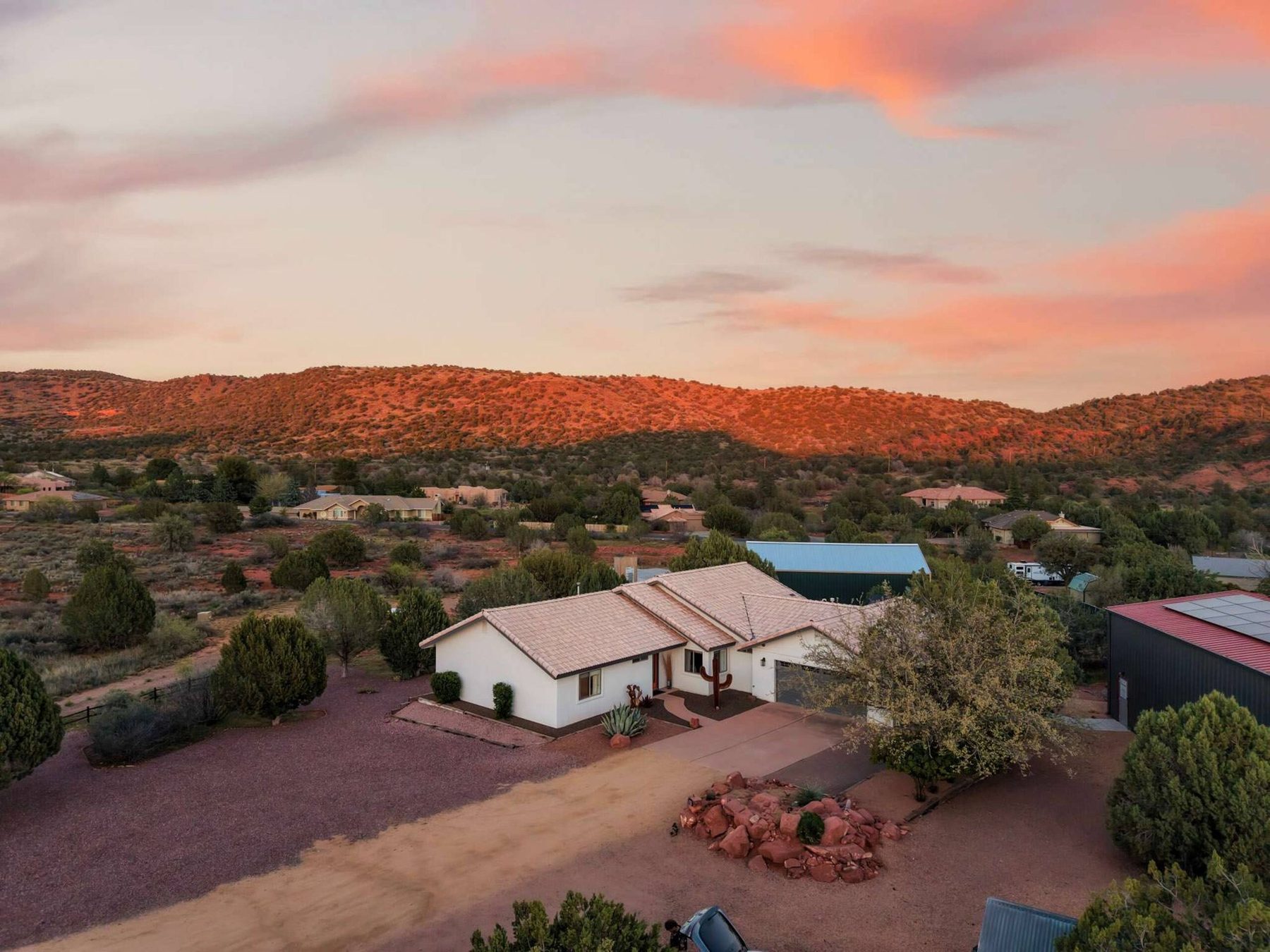
Photograph courtesy of Sedona Pickler.
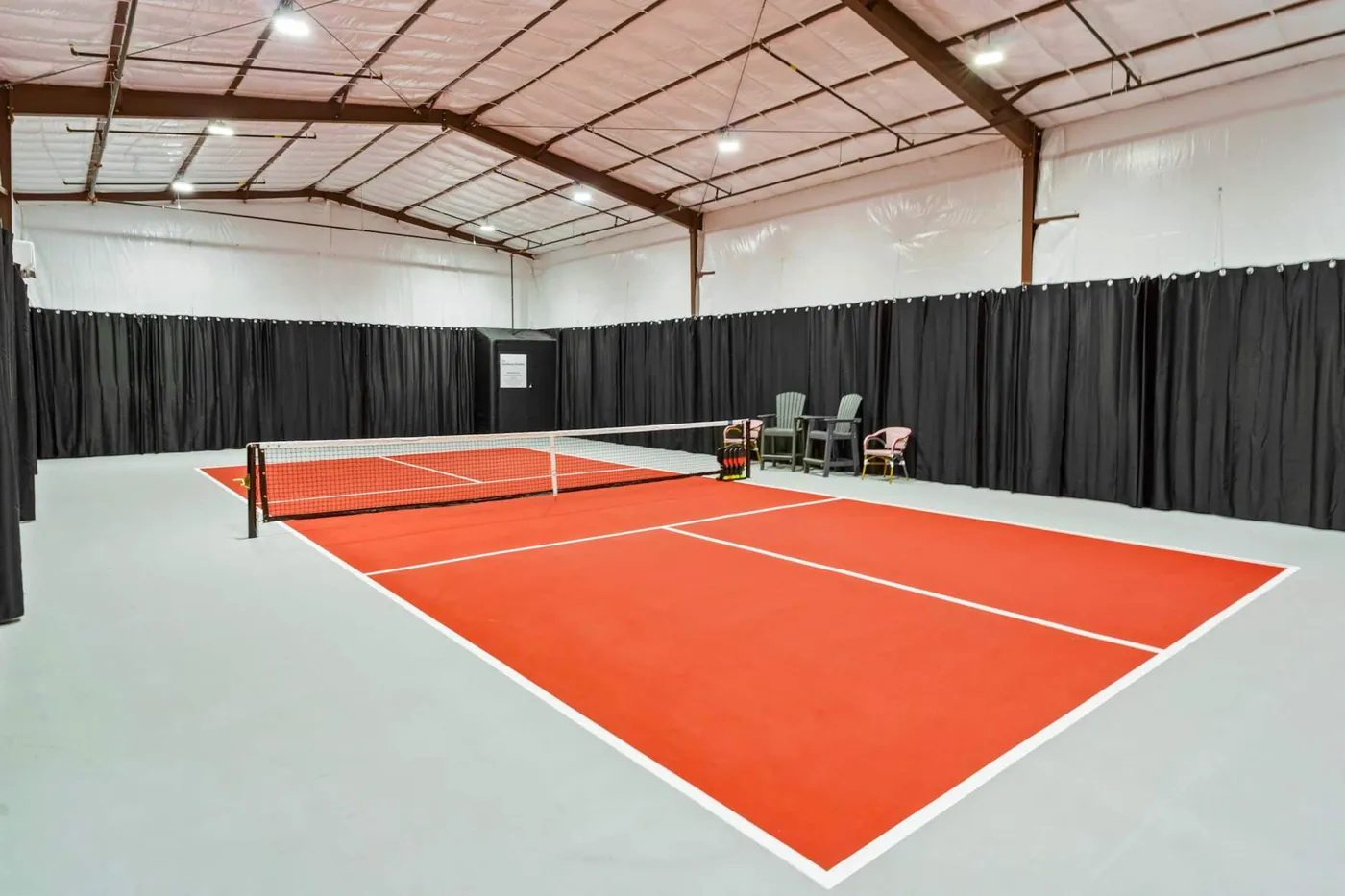
The building is 66 feet long and 36 feet wide, and its thermostat stays at 68 degrees all year. Those are the figures published by Sedona Pickler, a four-bedroom vacation rental in West Sedona, Arizona, for the feature it is named after: a private indoor pickleball court in a building of its own. The owners, Brian and Joanna Stoll, have published the court’s dimensions, its surface and its temperature. They have not published what it cost, what it costs to run, or what it has done to their bookings.
That leaves the question the trade asks of every large amenity, which is whether it can pay for itself. This report does not answer it for this house, because the inputs that would settle it are held by Brian and Joanna Stoll and by nobody else. What it does is assemble the public figures around the house: the City of Sedona’s rental and hotel numbers, the season the court is aimed at, the argument over supply, the state law and its price list, the lodging-tax tables, the court costs that are on the record and the participation counts. Then it lays out the payback sum with each input marked public or not.
One number frames the rest. In August 2025, according to the city’s Tourism Program, Airbnb listings in Sedona’s residential zones were 30.6% occupied. In October they were 60.5% occupied. An air-conditioned court is an argument about the first of those figures.
The asset: 2,376 square feet built for one game
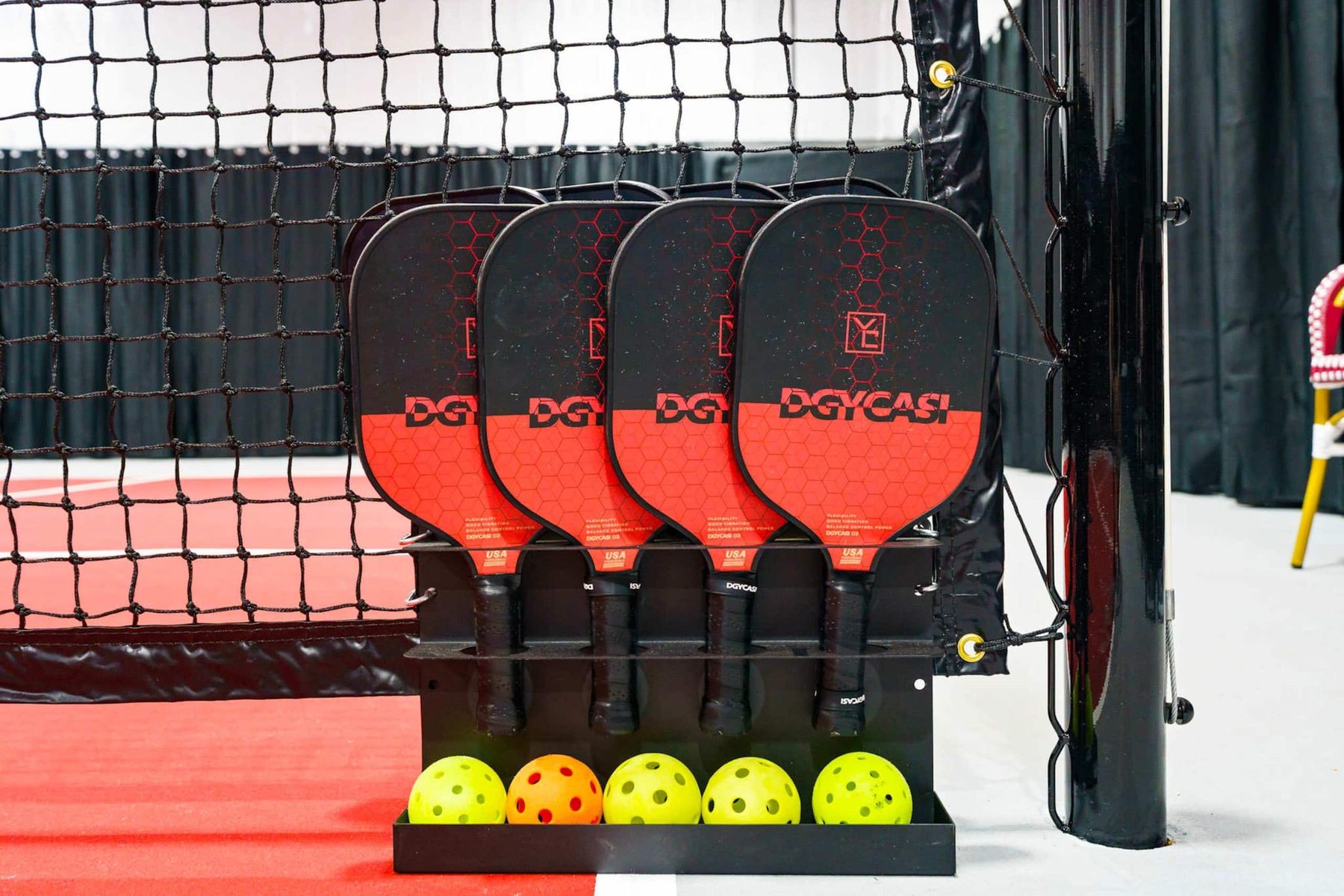
The court building measures 66 by 36 feet, according to the facts the house publishes for journalists, which comes to 2,376 square feet under one roof. The official playing area of a pickleball court is 20 by 44 feet, a figure the site’s own reference page gives, so most of the floor is run-off around the lines. The press page describes an acrylic surface on a concrete slab in a building that is heated, air-conditioned and lit, with paddles and balls supplied and guests asked to bring court shoes. The court is for the booked group only. There is no reservation system and no per-game fee, and that matters to the sum that follows: the building earns nothing by the hour. Whatever it returns, it returns through nights sold at the house.
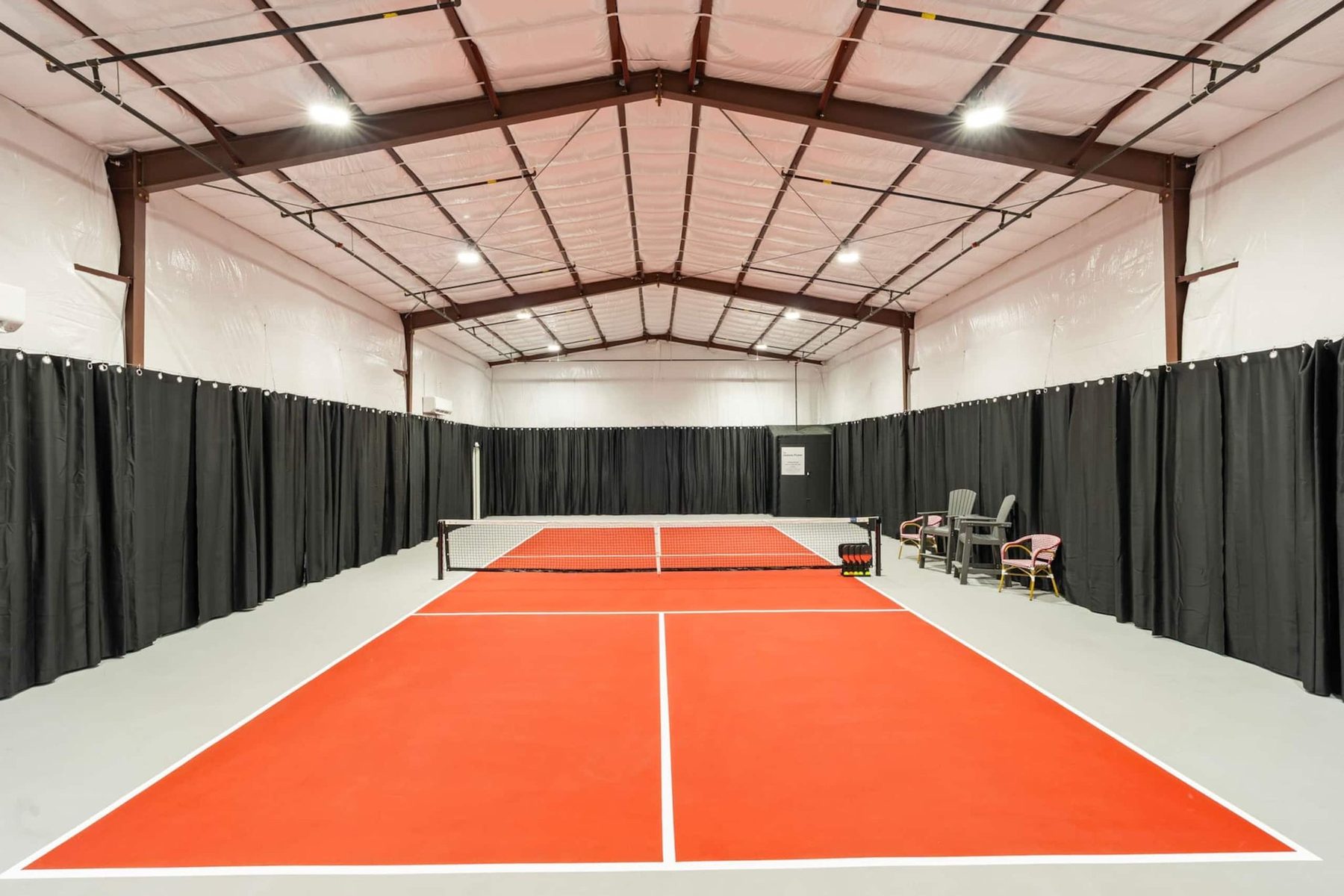
The house’s photographs show a clear-span steel frame, insulated walls and roof, perimeter curtains and a wall-mounted air-conditioning unit. From the air it is a dark metal building beside a white single-storey house, with other houses on similar lots nearby.
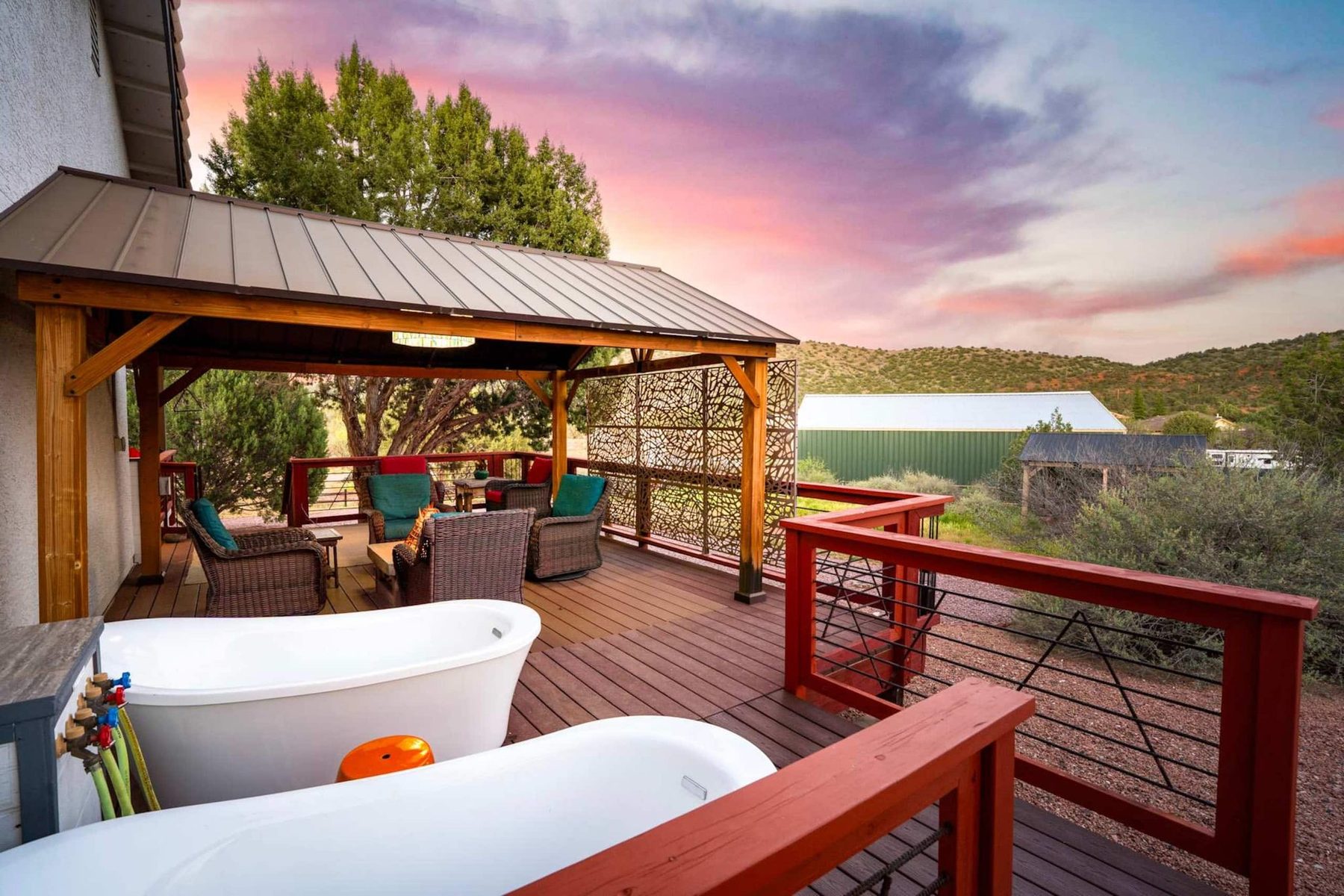
The house is listed at four bedrooms and two baths, sleeping eight across five beds. The site is plain about the count, calling it “three true bedrooms plus a bunk game room”. It is on one level, with a covered deck, a fire pit and two freestanding outdoor soaking tubs. There is no pool. The windows look onto high desert, with Sedona’s red cliffs in the distance. House rules hold occupancy to eight, set a two-night minimum and bar pets, parties and events. For a group weighing the place, the practical limits are those: two bathrooms for eight people, a fourth bedroom that is a bunk room, and no swimming.
One published line fixes the order of events. A guest from Kentucky wrote in a review dated May 2026 and reproduced on the home page: “We loved this house before the indoor pickleball court was added.” The first reviews there to mention the court carry the same month. This was a working rental with returning guests before the building went up. That makes it a clean case for a payback calculation: one house, one added asset, a before and an after. The before and the after belong to Brian and Joanna Stoll. No cost, completion date, energy bill, rate history or occupancy figure for the house has been published, and none is estimated here.
The site takes no bookings itself. Its date panel passes a visitor to Airbnb, Vrbo, Booking.com, a direct-booking site or a pickleball travel marketplace, each with its own fees. The house’s channel mix is not published either.
The market: $465.91 a night at 49.4% occupancy
Airbnb listings in the City of Sedona’s residential zones averaged $465.91 a night at 49.4% occupancy from January to October 2025, according to the October 2025 Lodging and Spending Reports issued by the city’s Tourism Program. Revenue per available night was $230.19, and the sample took in $75.5 million over the ten months. Vrbo listings in the same zones ran at 44.9% occupancy and $554.04 a night, for $51.3 million. Hotels in the report’s study area sold 67.2% of their rooms at $358.08, which made $240.69 per available room and $164.4 million in room revenue.
Occupancy, %
Occupancy, Jan to Oct 2025Occupancy, Oct 2025
| Segment | Occupancy, Jan to Oct 2025 | Average daily rate, Jan to Oct 2025 | Revenue, Jan to Oct 2025 | Occupancy, Oct 2025 | Average daily rate, Oct 2025 |
|---|---|---|---|---|---|
| Hotels | 67.2% | $358.08 | $164.4M | 74.8% | $446.31 |
| Airbnb rentals | 49.4% | $465.91 | $75.5M | 60.5% | $504.08 |
| Vrbo rentals | 44.9% | $554.04 | $51.3M | 52.9% | $589.29 |
Hotels are the report's Sedona+ study area (data from STR). Rentals are listings in the city's residential zones, scraped by Key Data; they are not tax receipts.
Source: City of Sedona Tourism Program, October 2025 Lodging and Spending Reports
Read across, the table says a Sedona rental on Airbnb charged $107.83 a night more than a Sedona hotel room and stood empty far more often: 17.8 percentage points separate the two occupancy rates. Multiply rate by occupancy and the gap nearly closes. Revenue per available night differs by $10.50, in the hotels’ favor. At the average listing, half the nights in a ten-month stretch went unsold.
The two sectors are moving in different directions. Hotel occupancy for the ten months was down 2.2% on the year before and room revenue down 1.5%, while the average rate rose 5.0%. Room-night demand fell 6.2% and supply fell 4.1%. The rental sample went the other way: Airbnb occupancy up 9.8%, average rate up 26.1%, revenue per available night up 38.5% and revenue up 12.5%.
The rental numbers need handling. The hotel figures come from STR, the hotel benchmarking firm, and rest on 21 reporting hotels with 1,792 rooms among 44 in the study area. The rental figures are scraped from Airbnb and Vrbo listings by Key Data. They are not tax receipts. A 26.1% rise in rate beside a 12.5% rise in revenue points to a changing mix of listings at least as much as to hosts raising prices by a quarter. The answer also shifts with the boundary. Airbnb occupancy for January to October was 36.8% across all zones of the city, 41.6% in what the report calls Greater Sedona and 37.7% in the Village of Oak Creek. The report does not identify listings, so no single house can be read out of it. These figures describe the market, not any one address.
The visitor behind the numbers does not stay long. In October 2025, the report says, visitors “spent an average of 1.1 days in market”, 67% stayed overnight and 46% had been before. HVS, the hotel consultancy, wrote in March 2026 that Sedona hotel occupancy held “within the high 60% range” from 2023 through 2025, and that 2025 brought visitation declines of 5% to 10% at northern Arizona destinations including Slide Rock State Park and Grand Canyon National Park. Rates are rising and volume is soft. At 49.4% occupancy an average rental has slightly more unsold nights than sold ones, so the unsold night is where a host has most to gain.
The season: 30.6% in August, 60.5% in October
Residential-zone Airbnb listings in Sedona were 30.6% occupied in August 2025, 43.1% in September and 60.5% in October, by the same City of Sedona report. Vrbo listings followed the same slope from a lower start: 26.7%, 38.5% and 52.9%. Between the low month and the high one, Airbnb occupancy moved 29.9 percentage points.
Occupancy, %
Airbnb listingsVrbo listings
| Month, 2025 | Airbnb listings | Vrbo listings |
|---|---|---|
| August | 30.6% | 26.7% |
| September | 43.1% | 38.5% |
| October | 60.5% | 52.9% |
Scraped listing data from Key Data. Only these three months were retrieved for this report.
Source: City of Sedona Tourism Program, October 2025 Lodging and Spending Reports
Heat is the plain reading of that slope. The house’s site publishes NOAA’s 1991 to 2020 climate normals for Sedona: an average daily high of 97°F in July, against 107°F in Phoenix, and 58°F in January. The site builds a pitch on the ten-degree difference, and the city’s visitor data shows who the pitch is for. Phoenix supplied 48.1% of Sedona’s visitors in October 2025, with Los Angeles at 3.7% and Tucson at 3.6%. The house’s site puts central Phoenix about two hours and 116 miles away by Interstate 17. Nearly half the market lives a short drive off in a hotter city, and the hot months are when Sedona’s rentals are emptiest. A court kept at 68 degrees is aimed at those months.
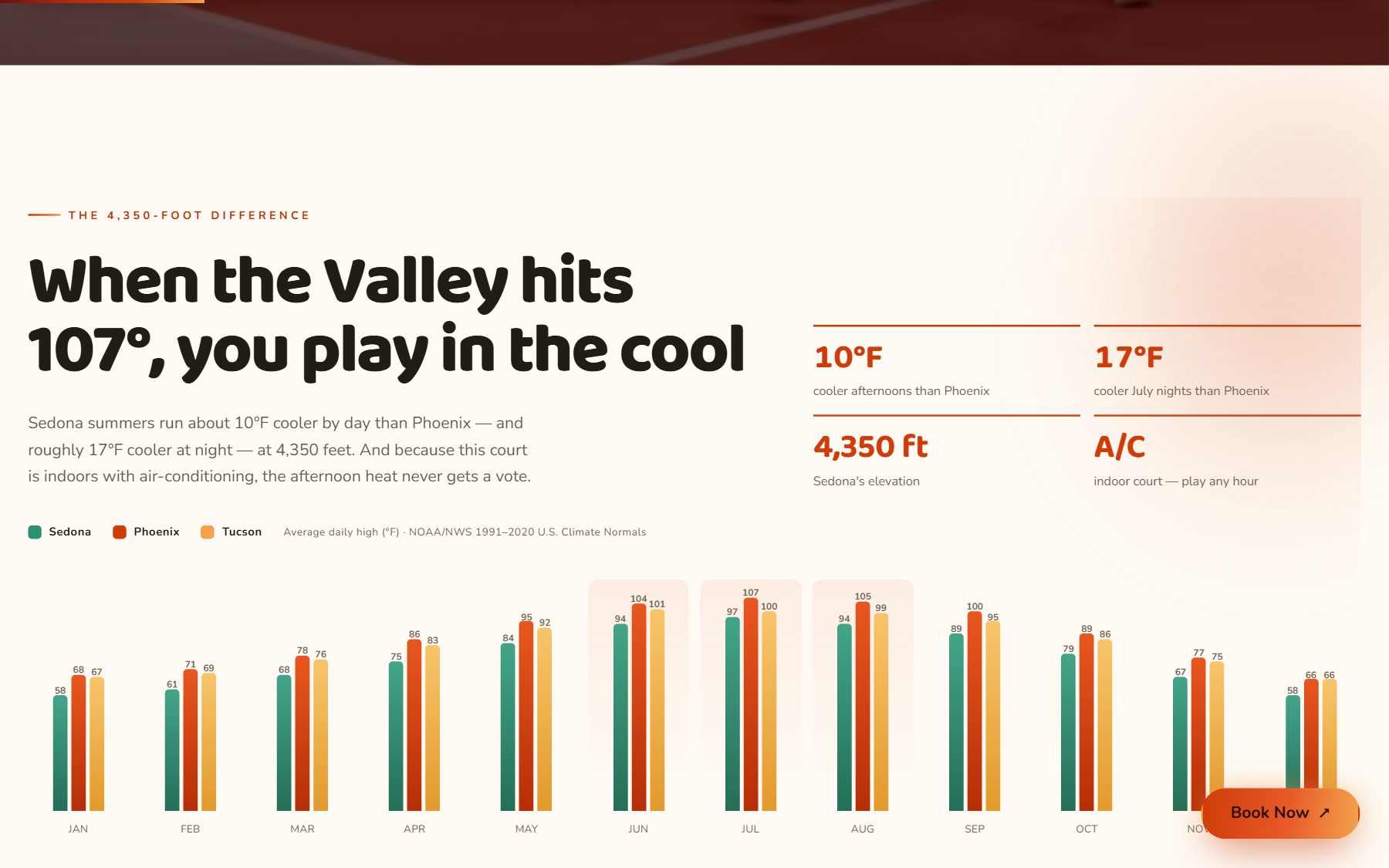
One guest review fits the logic and proves nothing beyond itself. A group that stayed in July 2026 wrote of the court’s “AC blasting a cool 68 degrees”. Whether the court moved the house’s own August away from the market’s 30.6% is the figure Brian and Joanna Stoll hold and the public does not.
What the gap is worth can be sized at market rates, as an illustration and nothing more. A move of 29.9 percentage points in a 31-day month is about nine nights. At the market’s ten-month average rate of $465.91, nine nights gross $4,193.19 and a single extra week grosses $3,261.37. Three cautions travel with those sums. The ten-month average is used because it is the figure in hand, and an August rate may differ from it. The sums are gross, before platform fees, cleaning and the cost of cooling the building. And they are the market’s averages applied to a hypothetical rental, not this house’s result.
Winter is the other half of the pitch: the court is heated, and January’s average high is 58°F. The monthly figures retrieved for this report run from August to October only, so that side cannot be sized here.
Supply: from about 400 rentals to more than 1,200
The City of Sedona went from about 400 short-term rentals in 2020 to more than 1,200 at the end of 2024, the Phoenix station AZFamily reported in early February 2025, citing the city. Scott Jablow, then the city’s mayor, told the station that rentals were nearly 20% of the city’s housing options and that 66% were owned by people living outside the city. Other counts of the same thing differ. ABC15 reported the same week that rentals were 16% of Sedona’s housing stock in 2024 and 18% a year later, with some neighborhoods near 40% by one resident’s tally of permits. In March 2026 the city’s lobbyist, Kathy Senseman, told state legislators that rentals make up a quarter of Sedona’s housing, according to Capitol Media Services reporting carried by KJZZ. The published share runs from 16% to a quarter depending on the speaker and the date. Each is printed here with its source, and none is averaged.
Listing counts are a second measure and a looser one. Key Data’s samples in the city’s report, as of April 2025, were about 1,550 Airbnb listings in the residential zones, about 2,425 across the city, about 3,525 in Greater Sedona and about 875 in the Village of Oak Creek. They run ahead of the permit count because one home can carry several listings and because scraped areas do not follow legal boundaries.
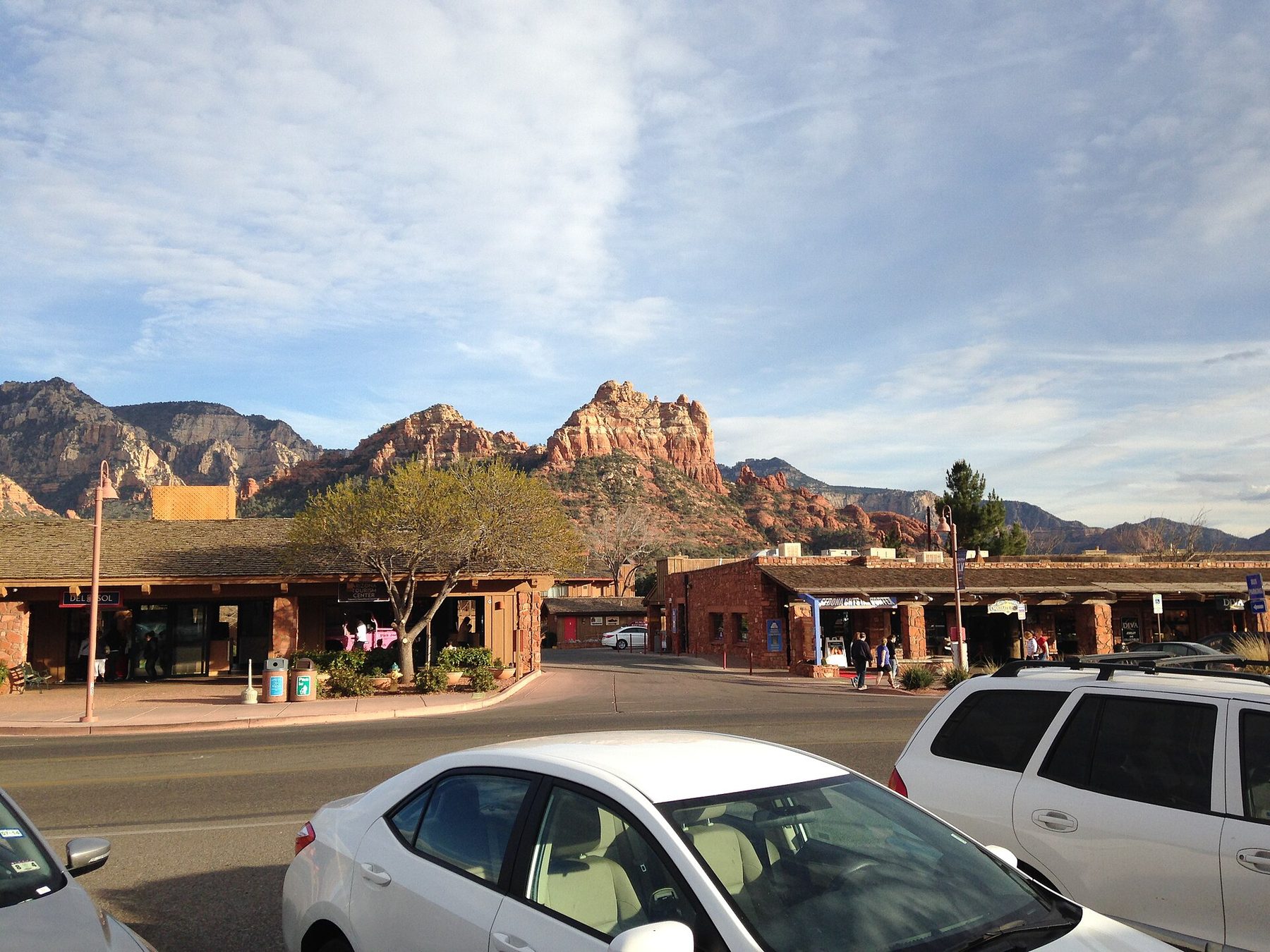
The politics follow from a ratio ABC15 gave: about three million tourists a year, about 3,000 hotel rooms and a population under 10,000. Jablow told the station his “own thought is a 5% cap” and said of rentals, “It’s pricing everybody out.” The same report carried the other side. Cameron Wylde, owner of Wylde Vacation Rentals, which the station said had 40 rentals, argued that rentals bring “tens of millions of dollars a year in bed tax” and put median home prices at “over a million dollars”. Expedia Group told the station that “simply limiting or banning vacation rentals is not a standalone solution to a housing crisis.” The city, ABC15 reported, planned up to 180 affordable units on three plots it had bought.
For the arithmetic of any single amenity, supply is the denominator. A rental count that roughly tripled between 2020 and the end of 2024 is the backdrop to a market in which the average residential-zone Airbnb listing is occupied 49.4% of the time. Under current state law, as the next section sets out, the number of rentals cannot be capped, so the competition for those nights does not ease by itself.
The law: a $250 permit ceiling, a $500,000 policy and no cap
Arizona limits what a city or county may charge for a short-term rental permit to “a fee not to exceed the actual cost of issuing the permit or license or $250, whichever is less”, under Laws 2022, chapter 343, the act known as SB 1168.
The frame dates from 2016. SB 1350, which became Laws 2016, chapter 208, and took effect after December 31 of that year, says: “A city or town may not prohibit vacation rentals or short-term rentals”. It bars regulating them by classification, use or occupancy, and leaves room for health and safety rules and for nuisance rules that apply to every home alike. The same limits bind counties. The same act set up state tax collection through online lodging marketplaces.
SB 1168 kept the ban on bans and gave cities, towns and counties a set of tools with numbers attached:
- A local permit or license, at no more than $250.
- Liability insurance of at least $500,000, unless the rental is offered through a marketplace that provides equal or greater cover.
- Notice to adjacent and facing single-family neighbors before the first rental.
- The permit number, or failing that the state transaction privilege tax license number, on every advertisement.
- Fines of up to $500, $1,000 and $3,500 for the first, second and third verified violation in twelve months, or one, two and three nights’ advertised rent, whichever is greater.
- Up to $1,000 for every 30 days an owner fails to supply an emergency contact.
- Suspension of a permit for up to twelve months after three verified violations in twelve months, or after one grave one.
A city must issue or deny a permit within seven business days. Nothing in the act lets any jurisdiction cap the number of rentals. The City of Sedona’s permit is annual and costs $210 per unit, according to a July 2026 guide to the city’s rules published by Lodgify, a rental software company.
In money terms the fixed cost of compliance is small. Sedona’s $210 a year is less than half of one night at the market’s average rate of $465.91. The exposure sits in the fine schedule, which is indexed to rent: a third violation costs the greater of $3,500 or three nights’ advertised rent, and a suspension can remove a year of revenue. The house’s own published rules exclude parties and events and hold a booking to eight guests, and the court is not hired out separately, so nights remain the only way the building earns.
The cap returned to the Legislature in 2026 and did not pass. HB 2429, sponsored by Rep. Selina Bliss, a Prescott Republican, began as a bill backed by the League of Arizona Cities and Towns to let cities cap rentals and space them apart. The Arizona Association of Realtors and Airbnb opposed it, Capitol Media Services reported on KJZZ. It was narrowed to an overnight occupancy limit of “two adults per bedroom plus two additional adults, excluding minors” and suspension after three violations in 24 months. It passed the House in March 2026 and then stalled in the Senate, the Sedona Red Rock News reported on April 25. Gov. Katie Hobbs separately proposed a tax of $3.50 a night on rental stays, AZFamily reported in February 2026, alongside an advocate’s estimate of about 70,000 short-term rentals statewide. The Legislature’s own site carries each bill’s final status.
The tax line: 13.325% on a Sedona night
A night in Sedona carries 13.325% in lodging taxes on the Yavapai County side of the city and 13.9% on the Coconino County side, according to the July 2026 table of transient lodging tax rates published by Northern Arizona University’s Arizona Hospitality Research and Resource Center. The Yavapai-side total stacks four layers: 5.5% for the state, 0.825% for the county, 3.5% for the city and a further 3.5% city bed tax.
Total lodging tax, %
| Place | City bed tax | City | County | State | Total |
|---|---|---|---|---|---|
| Sedona, Yavapai | 3.5% | 3.5% | 0.825% | 5.5% | 13.325% |
| Sedona, Coconino | 3.5% | 3.5% | 1.4% | 5.5% | 13.9% |
| Cottonwood | 3.5% | 3.5% | 0.825% | 5.5% | 13.325% |
| Camp Verde | 3.0% | 3.65% | 0.825% | 5.5% | 12.975% |
| Jerome | 3.0% | 3.5% | 0.825% | 5.5% | 12.825% |
| Prescott | 3.0% | 2.95% | 0.825% | 5.5% | 12.275% |
| Flagstaff | 0.0% | 4.486% | 1.4% | 5.5% | 11.386% |
| Scottsdale | 5.0% | 1.7% | 1.77% | 5.5% | 13.97% |
Sedona lies in two counties, so it has two totals.
Source: Northern Arizona University, Arizona Hospitality Research and Resource Center, Transient Lodging Tax Rates, July 2026
The spread among the places a northern Arizona traveler might choose is narrow. Flagstaff’s total is 11.386% and Prescott’s 12.275%. Cottonwood matches Sedona’s Yavapai County total, and Scottsdale’s 13.97% is the highest in the table. As an illustration on a round $500 night, the tax is $66.63 at Sedona’s 13.325% and $56.93 at Flagstaff’s 11.386%, a difference of $9.70.
The guest pays this tax, so it is not a line in an owner’s revenue. It belongs in the payback sum anyway, because guests compare all-in prices across destinations. The university reissues its tables several times a year, so the edition current on the day is the one to use.
Court costs on the public record: $1.54 million for eight
Sedona’s finance director, Cherie White, put construction of up to eight lit pickleball courts at Posse Grounds Park at $1.54 million and their design at $81,880 when the City Council unanimously approved $100,000 for design work, the Sedona Red Rock News reported in August 2023. Divided by eight, the two estimates come to roughly $200,000 a court for a lit public facility. That is the best-documented court cost in this market, and it is for courts with no roof.
At the other end is the home-improvement range. The rental manager AvantStay put a properly installed outdoor court at $20,000 to $50,000 in an August 2026 blog post that links the figure to HomeGuide, a cost-estimating site. Between a backyard slab and a municipal complex, the record offers nothing for what this house has: a single court inside an insulated, heated and air-conditioned building. No reliable public figure for that kind of structure was found for this report, and none is printed. Brian and Joanna Stoll have not published theirs.
Part of what any court costs is the price of keeping its sound away from other people. Sedona’s assistant public works director, Sandra Phillips, told the council the Posse Grounds courts would be “more than 400 feet from the nearest home”, which she said lowers the sound to about 58 decibels, the paper reported. Where the distance is not there, the price is quoted in walls. In north Scottsdale, the Stonegate Community Association proposed a pair of 12-foot walls priced at $140,000 beside a tennis court it had converted to pickleball, and homeowners voted the plan down, Gray Television stations reported in February 2023.
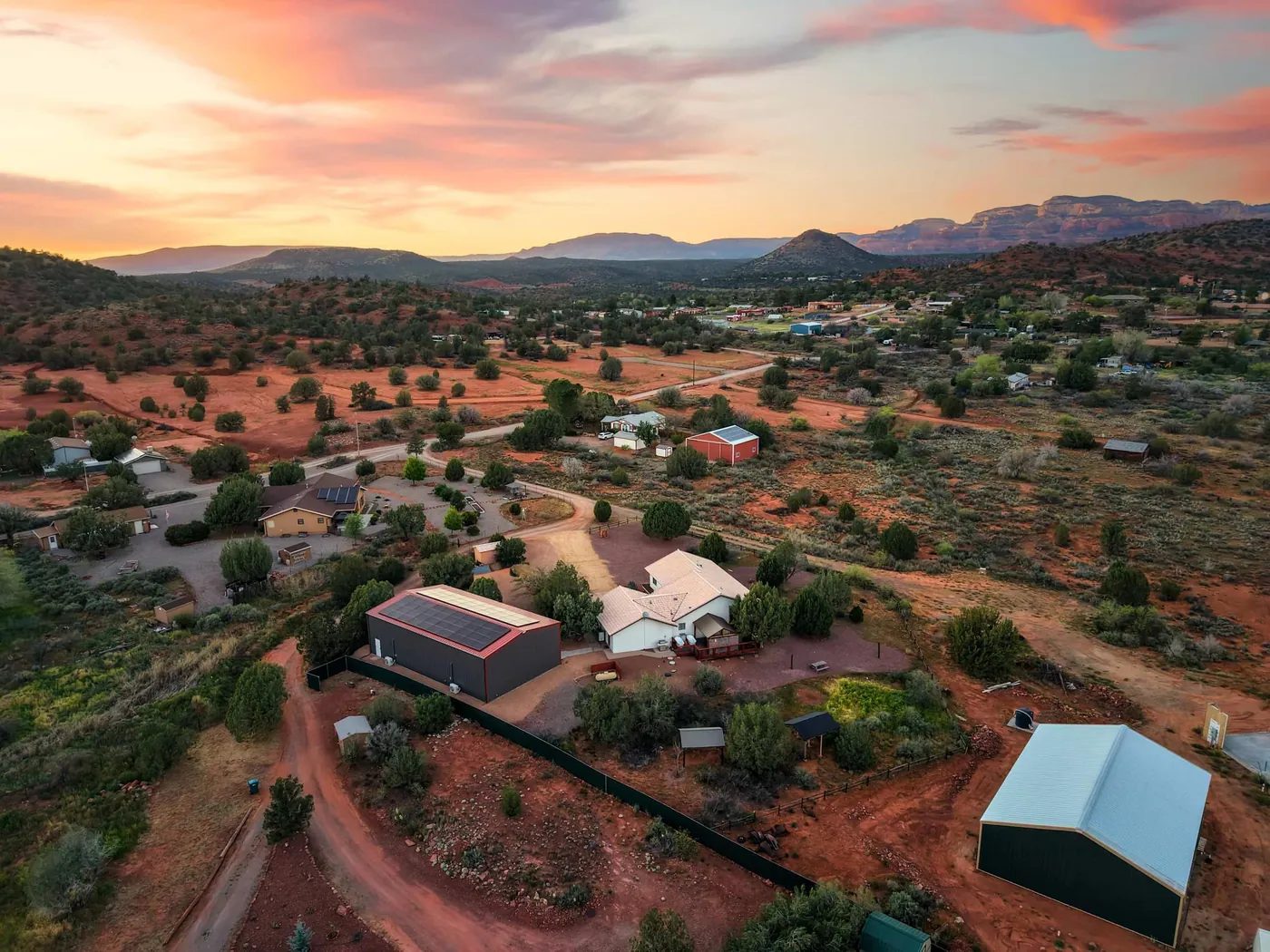
Outdoors, then, the full cost of a court is the slab plus either land or walls. A building stands in for both and, in a place with 97°F July afternoons and 58°F January ones, for the weather as well. It also brings costs an outdoor court never has: cooling and heating 2,376 square feet of tall space to 68 degrees all year, lighting it and insuring it. None of those running costs is published. Nor is any sound reading taken outside the building, so how much of the noise an enclosure of this kind removes is, on the public record, unmeasured.
Demand: 24.3 million players and a growth rate that has halved
About 24.3 million Americans played pickleball in 2025, according to the Sports & Fitness Industry Association, up from about 4.2 million in 2020, a rise of 479%. The association surveys 18,000 people aged six and over each year and counts anyone who played at least once.
The curve has bent. The association’s 2024 count was 19.8 million, as The Dink reported in March 2025, and its own release that May gave the rise over 2023 as 45.8%. For 2025 the rise was 22.8%, or about 4.5 million new players, Pickleball.com reported in April 2026 from the association’s latest report. That is half the pace of the year before. The association’s page still shows that the sport “grew 171.8% from 2022 to 2025”.
Most of those players are occasional. Pickleball.com’s account of the report puts casual players, who played one to seven times in the year, at 16.8 million, up 23.9%, and core players, at eight times or more, at 7.48 million, up 20.4%. A group that picks a rental because of its court is more likely to come from the 7.48 million than from the 16.8 million. That is an inference, not a survey finding, and it would put the addressable market at under a third of the headline count.
A larger number is in circulation and should not be set beside these. In March 2023 the Association of Pickleball Professionals put the number of adult Americans who had played in the previous twelve months at 48.3 million, from a one-off survey of adults whose published page gives no sample size. It cannot be joined to the SFIA series as a trend.
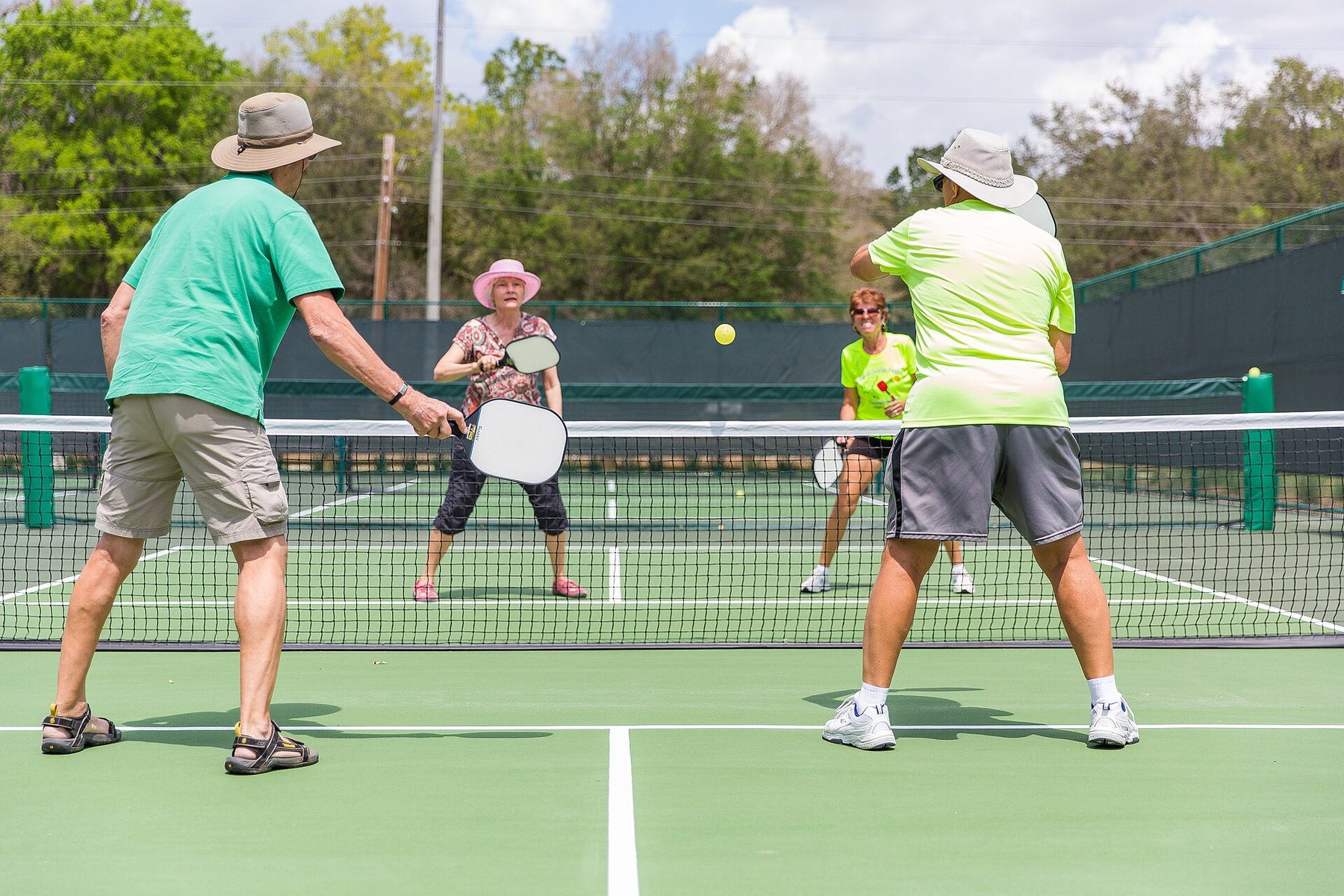
Courts are multiplying as fast as players. USA Pickleball counted 68,458 courts at 15,910 places to play at the end of 2024 and said 18,455 courts were added during the year, more than a quarter of the total. In Sedona, the 2023 council vote covered up to eight public courts, and a USA Pickleball ambassador, Christine Sturgeon, cited 200 to 300 players in the city, the Red Rock News reported. No public count of courts at private rentals, indoor or outdoor, exists.
What the demand figures cannot supply is a price. No published study from AirDNA, Key Data or AirROI that isolates a rate or revenue premium for a pickleball court was found for this report. The payback sum below therefore carries no premium figure at all.
The payback sum: 13 inputs, seven of them public
Booked News counts 13 inputs to a payback calculation for a court building at a Sedona rental, and the public record supplies seven of them. All seven describe the market. The six that are missing include every figure specific to the house.
| Input | Figure on the public record | Public or not public | Publisher |
|---|---|---|---|
| Cost of an enclosed court building | None found | Not public | Held by the owners |
| Running costs: cooling, heating, lighting, upkeep, insurance | None | Not public | Held by the owners |
| The house's nightly rate, before and after the court | None | Not public | Held by the owners |
| The house's occupancy, before and after the court | None | Not public | Held by the owners |
| Channel and management fees | None | Not public | Held by the owners |
| Rate or revenue premium for a court | No published study found | Not public | None |
| Market average daily rate | $465.91 | Public | City of Sedona, Jan to Oct 2025 |
| Market occupancy | 49.4%; 30.6% in August | Public | City of Sedona, 2025 |
| Lodging tax, paid by the guest | 13.325% or 13.9% in Sedona | Public | Northern Arizona University, July 2026 |
| Local permit fee | $250 ceiling; $210 in the City of Sedona | Public | Arizona Laws 2022, ch. 343; Lodgify, July 2026 |
| Liability insurance a city may require | $500,000 | Public | Arizona Laws 2022, ch. 343 |
| Players nationally | 24.3M; 7.48M core | Public | SFIA; Pickleball.com, 2026 |
| Largest visitor origin | Phoenix, 48.1% | Public | City of Sedona, October 2025 |
Public figures describe the Sedona market and Arizona law. None is a figure for Sedona Pickler.
Source: Booked News compilation from the sources named in each row
The sum itself is simple. Payback time is the cost of the building divided by the yearly net gain it produces. The gain is the extra nights sold multiplied by the rate, plus any premium earned on nights that would have sold anyway, less running costs and the channel fees on the added revenue. The first term needs the house’s occupancy before and after. The second needs its rates before and after. The third needs its energy, maintenance and insurance bills. The numerator needs the invoice. Brian and Joanna Stoll hold all four.
The market figures do allow a conversion rate, offered as an illustration at market averages and not as this house’s result. At $465.91 a night, every $10,000 of building cost equals between 21 and 22 nights of gross revenue. A reader who knows what a comparable building cost can scale from there. No cost figure is supplied here to complete the division, because the only public ones are for courts without walls.
The same figures show what would shorten or lengthen the wait. Shorter: extra nights won in the months when the market sits near 30%, a rate premium on nights already sold, and a feeder city that supplies 48.1% of visitors from two hours away. Longer: a participation curve growing at half its earlier pace, 18,455 new courts a year nationally, a hotel sector whose room-night demand fell 6.2% in the first ten months of 2025, and the cost of holding a tall building at 68 degrees through a 97°F July.
What the figures do and do not tell you
Seven of the 13 inputs are public, by this report’s count, and together they describe a market that half-fills its rentals at $465.91 a night, empties to 30.6% in August, taxes a Sedona night at 13.325% and cannot by law limit how many rentals compete. They support a case for why an owner might enclose a court. They do not show that doing so paid.
What the figures do not tell you
The city’s rental figures are scraped listing data from October 2025, not tax receipts, and newer monthly reports exist that were not retrieved for this article. Rental-share figures for Sedona range from 16% to a quarter by source. The participation counts come from surveys with different methods. No cost, rate, occupancy or revenue figure for Sedona Pickler is public, and every sum above uses market averages as an illustration.
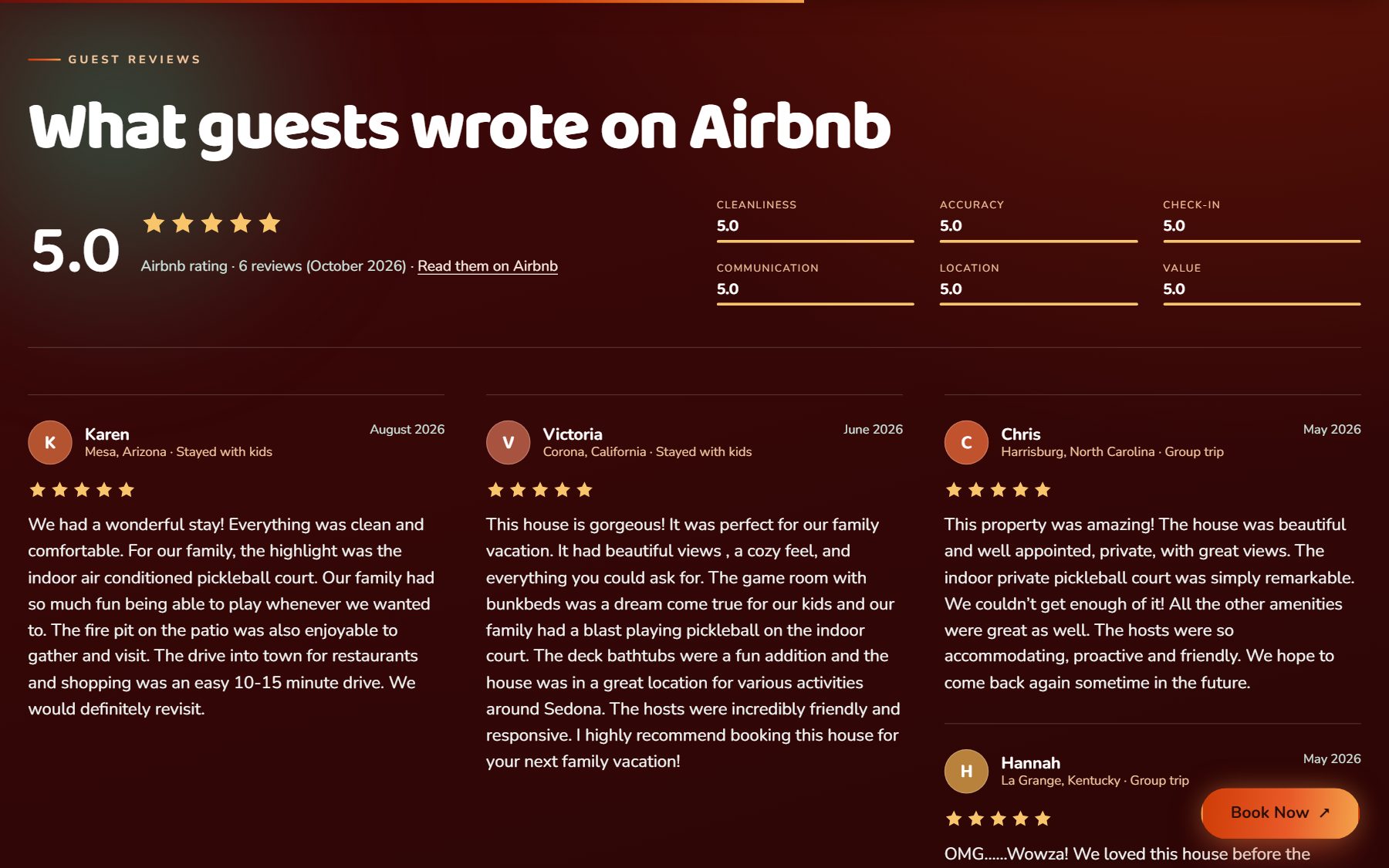
Guest ratings do not fill the gap. The house’s home page shows an Airbnb rating of 5.0 across six reviews as of October 2026, with all six reproduced there, and several mention the court. Six reviews is a small sample, and a rating measures satisfaction among people who booked. It says nothing about how many more of them there were.
Three things would close the sum. The first is the owners’ own figures: what the building cost, what it costs to run, and the house’s rate and occupancy before and after the court was added. The second is a cut of platform data by amenity, which the firms that scrape Airbnb and Vrbo are placed to produce and, as far as this report could find, have not published. The third is time. The city’s monthly reports will show whether the August trough is filling across the market, which would say something about summer demand in general and nothing about courts in particular.
The house’s own account of the court, its rules and its guest reviews is on its website, at sedonapickler.com. Until the house’s own figures are published, the arithmetic of an indoor pickleball court at a Sedona rental has a market side the public can see and a house side it cannot.
Common questions
Has the indoor pickleball court at Sedona Pickler paid for itself?
Nobody outside the owners can say. Brian and Joanna Stoll have not published what the court building cost, what it costs to run, or the house's rates and occupancy before and after it was added, and those are the inputs the calculation needs.
How full are Sedona short-term rentals?
Airbnb listings in the City of Sedona's residential zones were 49.4% occupied from January to October 2025, according to the city's Tourism Program. The figure was 30.6% in August and 60.5% in October. The data is scraped from listings by Key Data and is not tax receipts.
What is the lodging tax on a Sedona rental night?
Northern Arizona University's July 2026 table gives 13.325% on the Yavapai County side of Sedona and 13.9% on the Coconino County side. The Yavapai-side total stacks the state's 5.5%, the county's 0.825%, the city's 3.5% and a further 3.5% city bed tax. The guest pays it.
Can Sedona cap the number of short-term rentals?
No. Arizona law since 2016 bars cities and counties from prohibiting short-term rentals, and the 2022 act that allowed local permits gave no power to cap their number. A 2026 bill that began as a cap proposal was narrowed and then stalled in the Senate, the Sedona Red Rock News reported in April 2026.
What does a pickleball court cost to build?
Sedona estimated $1.54 million in 2023 to build up to eight lit public courts, about $200,000 each. HomeGuide's range for an outdoor home court, as quoted by AvantStay, is $20,000 to $50,000. No reliable public figure was found for a single enclosed, air-conditioned court building.
Sources
- Sedona Pickler, Home page: the house, its rules, climate figures and the six guest reviews (read October 2026).
- Sedona Pickler, Press page: facts about the court building (read October 2026).
- City of Sedona Tourism Program, October 2025 Lodging and Spending Reports (Internet Archive copy; hotel data from STR, rental data from Key Data) (October 2025).
- Lodgify, Sedona Short-Term Rental Regulations: What Hosts Need to Know (July 2026).
- HVS, Sedona's Lodging Market: Resilience and Pricing Power (March 2026).
- AZFamily, Short-term rentals could be to blame for Sedona housing shortage (February 2025).
- ABC15 Arizona, Sedona leaders say vacation rentals are driving a housing shortage emergency (February 2025).
- KJZZ (Capitol Media Services), Arizona short-term rental bill now goes after ‘repeat bad actors’ to limit overnight occupancy (March 2026).
- Sedona Red Rock News, Senate stalls Bliss' STR bill indefinitely (April 2026).
- Sedona Red Rock News, Sedona approves pickleball courts at Posse Grounds Park (August 2023).
- AZFamily, Arizona lawmakers target short-term rentals with new restrictions, taxes (February 2026).
- Arizona State Legislature, Laws 2016, chapter 208 (SB 1350), online lodging (2016).
- Arizona State Legislature, Laws 2022, chapter 343 (SB 1168), short-term rentals (2022).
- Northern Arizona University, Arizona Hospitality Research and Resource Center, Transient Lodging Tax Rates: Arizona Communities (July 2026).
- Sports & Fitness Industry Association, U.S. Pickleball Participation (2026).
- Sports & Fitness Industry Association, SFIA releases Single Sport Reports for pickleball and from the team sports category (May 2025).
- The Dink, Report: pickleball participation surges to nearly 20 million in 2024 (March 2025).
- Pickleball.com, SFIA report confirms over 24 million Americans playing pickleball (April 2026).
- Association of Pickleball Professionals, New APP Research Reveals Nearly 50 Million Adult Americans Have Played Pickleball In The Last 12 Months; Average Age Drops To 35 (March 2023).
- USA Pickleball, 2024 USA Pickleball Annual Growth Report (January 2025).
- WFSB (Gray Television), Addition of pickleball courts pits neighbor against neighbor, leads to lawsuits (February 2023).
- AvantStay, Pickleball Court ROI for Vacation Rentals: 2026 Cost Analysis and Profit Breakdown (August 2026).
A note on this story: Booked News's publisher works with Sedona Pickler on its marketing. The facts here come from the house's published pages and the public sources listed above. Sources were read on or before 11 October 2026. To report an error, write to the desk; see the corrections policy.

More features
 Photograph by Wilfredor, CC0, via Wikimedia Commons.Market report · ReturnsForeign Buyers in Rio's South Zone by the NumbersBy Callum Reid · 20 min read
 Photograph by Ekrem Canli, CC BY-SA 4.0, via Wikimedia Commons.Market report · OccupancySouth Maui Vacation Rentals in 2026 by the NumbersBy Amara Osei · 19 min read
 Photograph by CaptJayRuffins, CC BY-SA 4.0, via Wikimedia Commons.Market report · ReturnsSt. Croix Against St. Thomas and St. John in Villa and Home-Price NumbersBy Ruth Okafor · 20 min read
Comments