Sarasota Vacation Rental Registration Fees Rise to $500 as Listing Count Reaches 700
Sarasota has updated its vacation rental ordinance across roughly 700 properties, raising new registration fees to $500 and imposing 24-hour response rules.
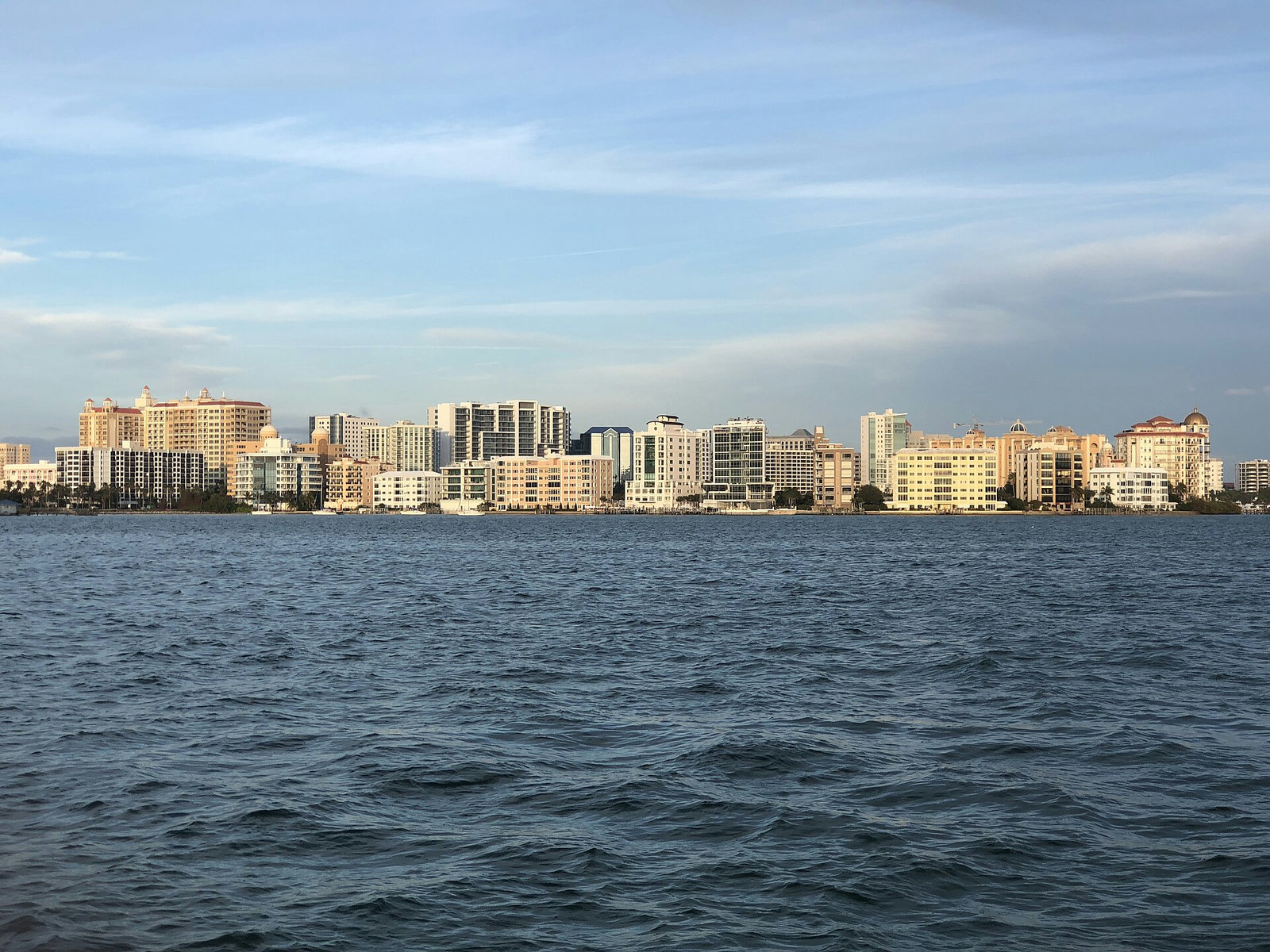
The skyline of Sarasota, Florida, viewed from Bird Key Park in 2018. Photo: “Sarasota Skyline” by Cullen Morgan, licensed CC BY 4.0, via Wikimedia Commons. Resized from the original.
Sarasota's citywide vacation rental ordinance covers roughly 700 short-term rental properties that must now comply with tighter operational requirements, mandatory safety inspections, and elevated fee structures, according to reporting from FOX 13 Tampa Bay and local media outlets. The regulatory updates apply to properties operating under an existing ordinance implemented before July 23, 2025, as city officials move to handle resident complaints concerning parking, safety, and noise on residential blocks.
Under the updated municipal framework, property owners face higher upfront registration charges, annual certificate renewals, and strict response times for designated emergency contacts. The Sarasota City Commission approved the adjustments to strengthen local oversight and fund administrative staff responsible for monitoring compliance across residential neighborhoods.
What the data shows
The numbers surrounding Sarasota's short-term rental market show a regulated inventory of roughly 700 active properties subject to municipal rules. According to FOX 13 Tampa Bay, the Sarasota City Commission voted to amend the city's existing citywide vacation-rental regulations after fielding complaints regarding loud parties, parking issues, and safety concerns in residential zones.
Per the station's report, registration fees for new short-term rentals jumped to $500, while renewal fees were set at $350. City officials stated that this fee increase is intended to cover the municipal expense of enforcing the updated regulations. Sarasota Mayor Liz Alpert told the station that the city plans to expand its operational setup, stating,
“We are going to be looking at hiring extra staff to administer this.”
Data points published by local media also show localized growth in listing density on individual streets. According to yourobserver.com, a resident in the Gillespie Park neighborhood reported that when she moved to her block in 2017, there were 2 Airbnb properties nearby. At the time of the commission's regulatory review, she counted 14 short-term rentals on her street alone.
How it was measured
The metrics detailing Sarasota's vacation rental sector originate from municipal votes, city registration filings, and local media reports summarizing official actions. FOX 13 Tampa Bay reported the $500 new registration fee, $350 renewal fee, and updated emergency contact rules based on city commission proceedings and official statements.
Yourobserver.com reported that the Sarasota City Commission unanimously approved 14 points of clarification and alteration to the city's vacation-rental ordinance on July 21, 2025. The City of Sarasota maintains an official registration portal indicating that vacation rentals are permitted within residential zoning districts citywide, provided property owners meet registration rules.
Regulatory reporting from avalara.com provided compliance specifications regarding inspection protocols, tax registration rules, and occupancy formulas. None of the reporting sources published a line-item methodology detailing how the baseline count of roughly 700 short-term rental properties was calculated across individual booking platforms such as Airbnb, Vrbo, or Booking.com.
Fee Structures and City Staffing
The increase in initial and recurring registration costs alters the entry baseline for short-term rental hosts in Sarasota. The $500 registration fee for new listings creates a direct upfront cost before a property can generate booking income, while the $350 annual renewal fee adds an ongoing operational expense. City leaders established these fees specifically to offset administrative costs and fund personnel dedicated to regulatory enforcement.
The administrative expansion described by Mayor Liz Alpert indicates that Sarasota is scaling up its local monitoring capacity. City personnel will oversee registration processing, recordkeeping, and enforcement actions. For property managers operating multiple listings across the city, the revised fee structure increases total recurring compliance costs across active portfolios.
Failures to maintain active registrations carry operational risks. Reporting from avalara.com notes that the city holds the authority to fine operators or suspend registration certificates for rule violations. A suspension halts a listing's ability to operate legally, exposing hosts to lost reservation revenue during non-compliant periods.
Operational Mandates and Taxation
Beyond baseline registration payments, Sarasota hosts must complete physical property verifications and maintain operational availability. According to avalara.com, short-term-rental hosts are required to obtain a vacation rental certificate of registration and pass a safety inspection before they can advertise or operate rentals booked for stays of less than 30 days. These inspections confirm that mandatory safety equipment is installed and functional on the property premises.
Once registered, hosts face mandatory contact regulations. Rules reported by FOX 13 Tampa Bay and avalara.com require property owners to designate one or two responsible parties who are reachable by telephone 24 hours a day, seven days a week. In the event of an operational issue or neighborhood complaint, the designated contact must be capable of physically reaching the rental property within one hour.
Tax compliance is tied directly to municipal registration. According to avalara.com, short-term rental operators must register for Sarasota County's tourist development tax. Hosts are required to collect this tax directly from guests for all stays lasting six months or less, and subsequently remit those collected revenues to county tax authorities.
Conflicting Occupancy Standards
Public reporting reveals differing accounts regarding maximum guest occupancy limits under Sarasota's rules. FOX 13 Tampa Bay reported that the city commission decreased maximum occupancy from 16 to 14 persons across covered properties. The station noted that properties operating prior to May 4, 2021, are exempt from this reduction.
Conversely, regulatory documentation summarized by avalara.com outlines an occupancy limit based on room count within single-family zones. Avalara's summary describes occupancy in residential single-family zone districts as limited to two people per bedroom, plus two additional people, or 10 people total, whichever figure is lower.
This gap in published figures represents a key point of evaluation for owners managing multi-bedroom properties. An occupancy limit capped at 10 persons under room-based rules restricts total guest capacity more tightly than a static 14-person cap, directly impacting potential group-booking revenue structures for larger residential structures.
Zoning Boundaries and Neighborhood Density
The scope of Sarasota's updated vacation rental rules is defined by specific municipal zoning boundaries. According to yourobserver.com, the ordinance applies to single-, two-, three-, and four-family dwellings located in residential single-family and multifamily zone districts. Properties located within the Downtown Edge and Downtown Neighborhood districts are explicitly exempt from these regulations because those districts are zoned for mixed-use development.
This zoning framework leaves traditional residential zones subject to full enforcement while exempting core mixed-use districts. However, rising listing concentration in areas like Gillespie Park, where one resident noted a surge from 2 Airbnb listings in 2017 to 14 on her street, has maintained pressure on city leadership to consider further legislative action.
In response to neighborhood concerns, Sarasota commissioners unanimously directed municipal staff to explore a neighborhood-specific amendment. This directive indicates that additional geographic restrictions or targeted rules could be applied to specific residential blocks experiencing high concentrations of short-term rental properties.
What to watch
Property owners, hosts, and real estate investors active in Sarasota can track several concrete operational points as enforcement of the updated ordinance proceeds.
- Monitor city staff updates regarding potential neighborhood-specific amendments that could target high-density streets in areas like Gillespie Park.
- Verify whether target properties fall within exempt mixed-use boundaries such as the Downtown Edge or Downtown Neighborhood districts.
- Establish clear scheduling arrangements with local property representatives to guarantee phone availability 24 hours a day, seven days a week, and physical site access within one hour.
- Confirm current registration certificate status prior to publishing property listings or accepting reservations for stays under 30 days.
- Track Sarasota County tourist development tax filing procedures for all bookings of six months or less to maintain dual compliance across municipal and county rules.
Figures checked by the standards desk (Paul Ostrowski): every figure in this story was matched to the source material listed below before publication.
Checked by the accuracy gate: 29 specifics checked, 28 traced to the source material, 1 general background, none removed.
Report an error in this story · Corrections policy and log

Related stories

Sarasota sets vacation rental occupancy limits as city listing count reaches 700

Hillsborough County approves short-term rental rules including $200 annual fee

Lisbon short-term rental accommodations drop 37% as cancelled units stay off housing market

Chatham raises short-term rental registration fee to $325 in second hike in two months
Read the desk every morning.
Leave your address for the Booked News briefing: the day's figures on rates, occupancy, demand, fees, supply and returns, each with its source, in one short email.
Comments