Hillsborough County considers $200 annual fee as local rentals reach 3,000
County records show 3,000 rentals in unincorporated areas alongside 9,000 in Tampa, as officials propose a $200 annual registration fee per unit.
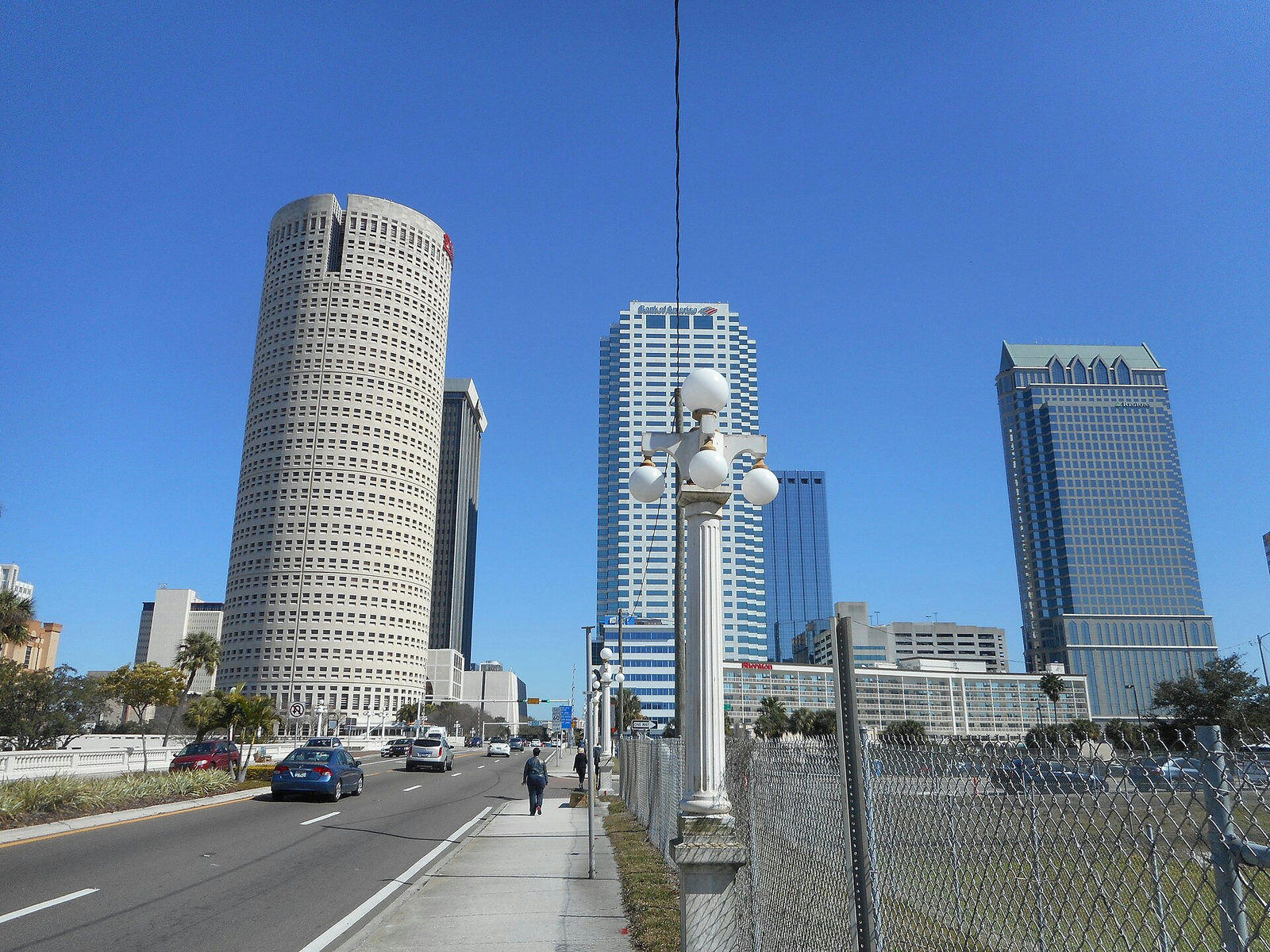
The downtown Tampa skyline seen beyond West Kennedy Boulevard in 2016. Picture from Wikimedia Commons: “Kennedy Bridge; Tampa-1”. Photographer DanTD. Licence CC BY-SA 4.0. Resized from the original.
Unincorporated Hillsborough County has about 3,000 short-term rentals, according to county information, as local commissioners evaluate a proposed ordinance that would introduce a $200 annual registration fee per unit. The proposed regulations would also mandate that property owners designate a local contact available around the clock to address operational issues and pay additional fees tied to property inspections.
The administrative framework arrives as municipal boundary lines illustrate sharp differences in total listing concentration across the Tampa Bay area. Figures reported by local authorities show about 9,000 additional short-term rentals operating in Tampa, while neighboring Pinellas County holds more than 24,000 short-term rentals across the county.
How the metric works
Municipal registration fees and unit counts function as baseline indicators of regulatory friction and market maturity in short-term rental markets. A fixed registration fee, such as the proposed $200 annual registration fee per unit in Hillsborough County, acts as a direct overhead expense for property operators. Unlike variable transaction taxes or platform booking commissions that scale with gross revenue, fixed annual fees increase recurring holding costs regardless of occupancy rates or nightly revenue performance.
Inventory figures measure the absolute volume of vacation rental properties active within specific legal jurisdictions. In county-level accounting, administrative boundaries create distinct operational environments. Unincorporated Hillsborough County contains about 3,000 short-term rentals under county jurisdiction, according to county information. The incorporated city of Tampa, located within the same county borders, contains about 9,000 additional short-term rentals subject to city-level rules.
Regional comparisons reveal how inventory concentrates in neighboring markets. Pinellas County, situated directly across Tampa Bay, accounts for more than 24,000 short-term rentals across the county. Tracking inventory totals across these municipal borders shows where operator density has expanded and where local governments are moving to institute regulatory oversight.
How it was measured
The inventory and fee figures originate from Hillsborough County administrative updates reported by Bay News 9. County information established the baseline figure of about 3,000 short-term rentals in unincorporated Hillsborough County. County records and municipal tallies also established the count of about 9,000 additional short-term rentals in Tampa and more than 24,000 short-term rentals across Pinellas County.
At the neighborhood level, inventory density tracking in the Bay Crest Park community in Town ‘N Country was conducted through local resident property counts. Residents identified 126 short-term rentals among roughly 900 homes in the neighborhood. The source material did not publish the underlying technical methodology, software scrapers, or specific administrative database queries used by municipal authorities to monitor these short-term rental listings.
Regulatory compliance and operating costs
When local governments transition from unregulated monitoring to mandatory compliance systems, the cost structure for short-term rental hosts changes in two distinct ways: fixed cash outlay and operational compliance requirements. The proposed $200 annual registration fee per unit imposes an immediate monetary cost, supplemented by additional fees related to property inspections.
Beyond direct fees, the requirement to maintain a local contact who can respond around the clock introduces an ongoing operational obligations structure. For non-resident owners or multi-unit real estate investors, satisfying a round-the-clock contact requirement often requires contracting with professional property management firms or local service providers, adding an extra layer of operational cost.
Neighborhood testimony highlights how residents perceive the absence of life safety oversight in residential zones. In Bay Crest Park, homeowner Samantha Freeland described the shift in residential street activity following storm recovery periods.
“We’re essentially having businesses that are operating within single-family zoned residential neighborhoods,” Freeland said. “That the county has zoned us as single-families zoned residential areas and they’re allowing businesses to operate right next to families with no ordinances or life safety inspections.”
Mandatory inspection requirements and annual registration systems establish formal entry barriers designed to enforce life safety compliance across residential housing stock.
Post-disaster inventory shifts and neighborhood density
External supply shocks, including severe weather events, frequently accelerate changes in short-term rental market density. In the Bay Crest Park neighborhood of Town ‘N Country, severe flooding and physical damage caused by hurricanes Helene and Milton triggered structural turnover in the local housing stock.
Following property damage from hurricanes Helene and Milton, multiple homeowners sold their residential properties. A portion of the buyers converted those single-family properties into vacation rentals. This sequence of transactions resulted in 126 short-term rentals among roughly 900 homes within Bay Crest Park.
This neighborhood concentration demonstrates how local inventory clusters can form rapidly after severe weather shocks. When traditional long-term owner-occupiers exit a flood-impacted area, real estate buyers frequently evaluate short-term rental execution as a capital recovery strategy. When density reaches 126 short-term rentals among roughly 900 homes, neighborhood residents report increased party activity, elevated traffic volume, and general residential disruptions, prompting county commissioners to schedule public hearings on regulatory oversight.
Cross-jurisdictional supply comparisons
Short-term rental density varies sharply between neighboring West Florida jurisdictions. Unincorporated Hillsborough County supports about 3,000 short-term rentals across its land area, according to county information. By contrast, Tampa contains about 9,000 additional short-term rentals within its municipal boundaries.
Looking broadly at the regional market, Pinellas County maintains a much larger footprint, with more than 24,000 short-term rentals across the county. For real estate investors evaluating market entry in the Tampa Bay area, these figures illustrate substantial supply differences:
- Unincorporated Hillsborough County represents a lower total inventory environment at about 3,000 short-term rentals.
- Tampa represents a moderate density urban environment with about 9,000 additional short-term rentals.
- Pinellas County represents a high-density regional market with more than 24,000 short-term rentals across the county.
These supply disparities influence how local commissioners approach municipal enforcement. While unincorporated Hillsborough County accounts for a smaller total count than Tampa or Pinellas County, localized neighborhood density in places like Bay Crest Park drives legislative action independent of broader countywide totals.
Strategic implications for operators and investors
For short-term rental operators, property managers, and real estate investors, municipal fee proposals require direct adjustments to financial modeling and asset management routines. A mandatory $200 annual registration fee per unit increases baseline holding overhead. When combined with inspection fees and local contact obligations, small-scale hosts with low annual occupancy face higher percentage drops in net operating income than high-volume operators.
Investors evaluating acquisitions in single-family neighborhoods must assess local legislative timelines. Hillsborough County commissioners scheduled a public hearing for 10 a.m. on Wednesday to address the proposed registration fees, inspection requirements, and round-the-clock contact rules. Tracking municipal commission schedules allows operators to anticipate regulatory compliance costs before purchasing or converting residential assets.
What to watch
Short-term rental hosts, property managers, and market investors in Hillsborough County should monitor concrete policy indicators and compliance requirements:
- Public hearing outcomes from the Hillsborough County commission regarding the proposed $200 annual registration fee per unit and inspection structures.
- Life safety inspection requirements and scheduling processes established by local code enforcement officers.
- Inventory shifts in Bay Crest Park and surrounding Town ‘N Country subdivisions following formal ordinance adoption.
Figures checked by the standards desk (Paul Ostrowski): every figure in this story was matched to the source material listed below before publication. 1 figure that could not be matched was removed.
Tally from the accuracy gate: 20 details tested, 18 found in the stored source, 2 allowed as background knowledge, nothing cut.
Sources
- Bay News 9 - Hillsborough County considers new rules for short-term rentals (September 2, 2026).
An analysis column by the Booked News desk. Every figure is taken from the sources above.
Is a figure here wrong? Say so / The corrections procedure and the log

Related stories
Hillsborough County approves short-term rental rules including $200 annual fee
Sarasota Vacation Rental Registration Fees Rise to $500 as Listing Count Reaches 700
Picture from Wikimedia Commons; licence CC BY 4.0; photographer Cullen Morgan

Malaysia drafts short-term rental rules with potential 180 night annual cap
Picture from Wikimedia Commons; licence CC BY-SA 4.0; photographer HundenvonPenang

Airbnb revenue rises 17% as host fee and rule changes reshape supply economics
Read the desk every morning.
Leave your address for the Booked News briefing: the day's figures on rates, occupancy, demand, fees, supply and returns, each with its source, in one short email.
Comment thread